
Of everything Salesforce announced at Dreamforce 2026, AIforce was the one that reframed the platform. Marc Benioff called the event a “refounding” for the AI era, and AIforce is the piece that makes that more than a slogan. If you run a Salesforce org, it is worth understanding what it is before the sales conversations start — because it changes what “good” looks like for the platform you already own.
The one-line version
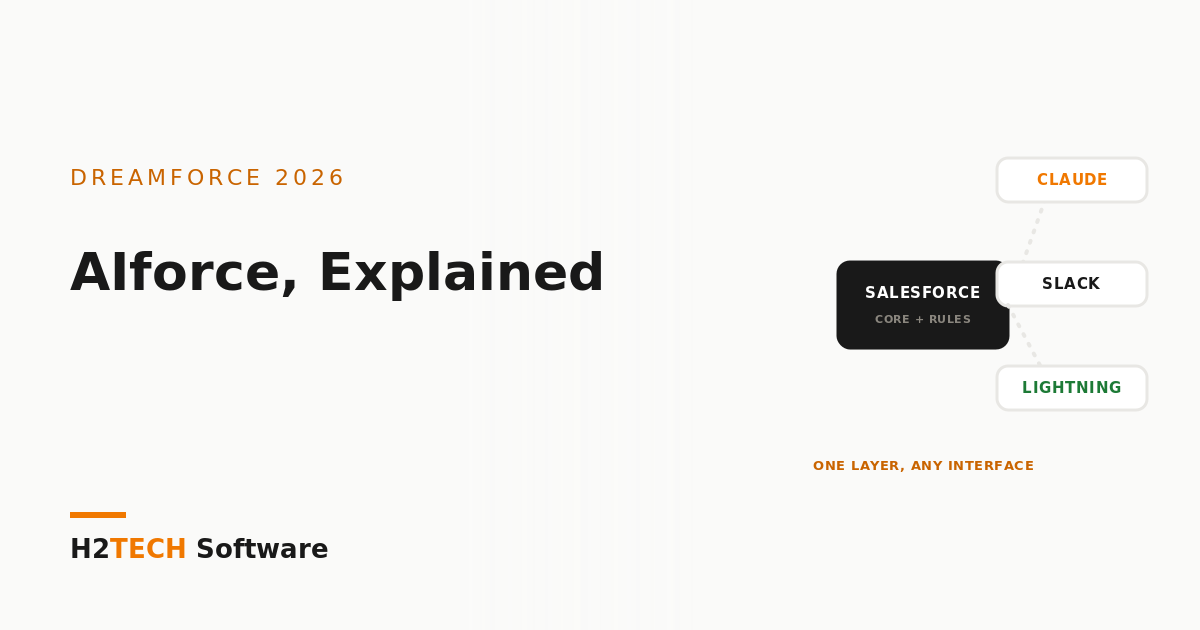
AIforce is a live interface layer that brings the full power of Salesforce to wherever people and agents already work. The data, workflows, business logic, semantics, permissions, security, and governance that run inside your org become reachable from other surfaces — from Claude, from Slack, or from an assistant embedded in Lightning. Someone can look up a record, update an opportunity, or trigger a workflow without opening a Salesforce tab, and the answer comes back with the same rules that apply inside the app. Salesforce put it more bluntly on the keynote stage: AI replaces the UI.
Why this is bigger than a feature
For most of Salesforce’s history, the value lived behind the Salesforce screen. To get anything out of the platform, you went to the platform. AIforce inverts that. It is powered by what Salesforce calls a Headless Toolkit, which exposes the platform through MCP servers, APIs, plug-ins, and skills, and it launched alongside three things that sit on top of it: Claudeforce, Slackforce, and Agentforce Coworker. The common thread is that your CRM stops being a destination and becomes a service that other tools call.
That is a genuinely different model, and it is the reason the announcement mattered more than any single feature. The question stops being “what can I do inside Salesforce” and becomes “what can any trusted tool do with my Salesforce.”
The part that matters most: governance
Here is the detail buyers should not skim past. Every request through AIforce runs on your existing permissions and business rules, so an agent only ever sees what the person interacting with it is allowed to see. Salesforce is also emphasising a strict “zero data retention” stance: connected model providers use your business data to answer a question, but do not keep it or train on it.
That is the right design. But it comes with a catch that is easy to miss in a keynote. AIforce inherits your governance — all of it, good and bad. If your sharing model is loose, your field-level security is inconsistent, or a field called “Region” actually stores a sales team, an AI surface will expose those flaws faster and to more people than a human clicking through screens ever did. The safety promise is real, but it is a promise about the platform, not about your specific org.
What it changes for an org you already run
Three practical implications follow, and none of them require you to buy anything new to start on.
First, your data model and permissions are now your AI interface. They stopped being back-office plumbing the moment they became the thing agents reason over. Getting them right is no longer a hygiene task; it is the user experience.
Second, messy data becomes customer-facing sooner. An assistant that answers from a duplicated account or a stale owner does it confidently and at speed — the same failure mode we wrote about in clean data before you deploy an AI agent, now with a wider blast radius.
Third, adoption shifts. The old work was training reps on screens. The new work is making the underlying org trustworthy enough that you are comfortable letting an agent act on it. That is a governance and data-quality project far more than a UI one — the same lesson behind getting Agentforce into production rather than proof-of-concept.
Where we sit on this
None of this is a reason to panic-buy. It is a reason to get your foundation in order, because AIforce rewards orgs that already have clean data and tight governance and punishes the ones that do not. That is the work we do: AI enablement built on a data foundation you can trust, delivered AI-native — we absorb the token and compute cost, and every AI output is reviewed by a certified engineer before it goes near a live record. The interface changed at Dreamforce. What makes it safe did not.
Key takeaways
- AIforce exposes your Salesforce data, logic, and governance to any AI surface — Claude, Slack, or Lightning — so work happens without opening Salesforce.
- Requests run on your existing permissions, and Salesforce promises zero data retention — but AIforce inherits whatever state your org is actually in.
- Your data model, permissions, and data quality are now your AI interface. Fixing them is the project, not the prerequisite.