
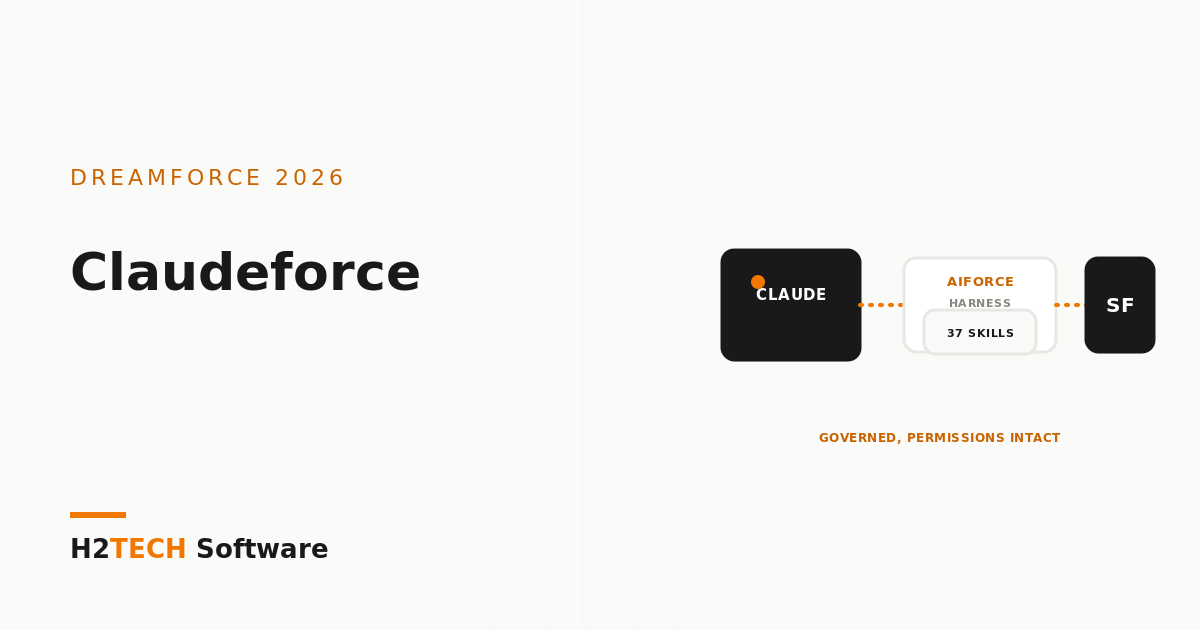
Claudeforce was one of the most talked-about announcements at Dreamforce 2026, and for good reason: it is the first flagship example of what AIforce actually enables. If AIforce is the layer that exposes Salesforce to any AI, Claudeforce is Anthropic’s Claude plugged into that layer. Here is what it does, what it does not, and what your org needs in place to get value from it.
What Claudeforce actually is
Claudeforce is an expanded partnership between Salesforce and Anthropic that brings Claude’s reasoning together with Salesforce’s enterprise data, workflows, business logic, and governance. The launch centrepiece is “Salesforce in Claude” — a plugin that ships with 37 prebuilt sales skills and runs as an MCP server inside Claude and Claude Cowork.
In practice, that means a seller can stay in Claude and ask for an update across their deals, get an answer grounded in live Sales Cloud data, and then take action — update a record, draft a follow-up, prep a meeting, review pipeline — without opening Salesforce. The permissions and governance of your org come along for the ride; the seller only sees and touches what they are allowed to.
Where it is in its lifecycle
This is worth being precise about, because timelines get blurred in the excitement. As announced, Salesforce in Claude is with select pilot customers now, with open beta opening in September 2026, and additional prebuilt skills rolling out through late 2026 and into 2027. So the direction is clear and the first skills are real, but the full library is still arriving. Plan around what is shipping, not around the roadmap.
The governance question, answered honestly
The most common question we get is the security one, and the answer is reassuring with a caveat. Because Claudeforce runs through the Salesforce enterprise harness, requests respect your existing permissions, sharing, and business rules, and Salesforce is emphasising a “zero data retention” posture — the model uses your data to answer but does not keep it or train on it.
The caveat is the same one that applies to the whole AI-era stack: this protects the platform boundary, not your internal configuration. If a sales rep can already see records they should not, Claude will surface those too — faster and more conversationally. The partnership handles the hard part of keeping your data out of a model’s training set. It does not fix an over-permissive org. That part is still yours, and for regulated and EMEA teams it deserves the same scrutiny we laid out in our Agentforce GDPR checklist.
How to get ready
Three things make the difference between a useful rollout and a risky one.
Start with permissions and sharing. Before you let anyone reason over live pipeline from a chat window, audit who can see what. The convenience of Claudeforce is exactly why loose sharing becomes dangerous — it removes the friction that used to hide the problem.
Then get your data honest. The 37 skills reason over your CRM as it is. Duplicate accounts, stale owners, and fields that do not mean what they say produce confident, wrong answers. If that sounds familiar, it is the same foundation work behind deploying any AI agent.
Finally, decide where a human signs off. Reading pipeline is low-risk. Sending a customer email or changing a forecast is not. Draw that line deliberately — it is the whole argument for keeping a review step on AI output even when the tool makes acting instant.
Why we are optimistic about it
We build AI-native, so a serious reasoning model working natively on governed CRM data is exactly the direction we want the platform to go. Claudeforce is not a reason to rip anything out; it is a reason to make sure the data and permissions underneath your org are ones you would be comfortable letting a very capable, very fast colleague act on. Get that right and the partnership pays off. Skip it and you have just given your worst data a faster microphone.
Key takeaways
- Claudeforce lets sellers work on live Salesforce data from inside Claude, via 37 prebuilt skills running as an MCP server — the first big use of AIforce.
- It is shipping in stages: pilot and early beta now, more skills through 2026–2027. Plan around what is live.
- Zero data retention protects the platform boundary; your permissions, sharing, and data quality are still your responsibility — get them right first.