
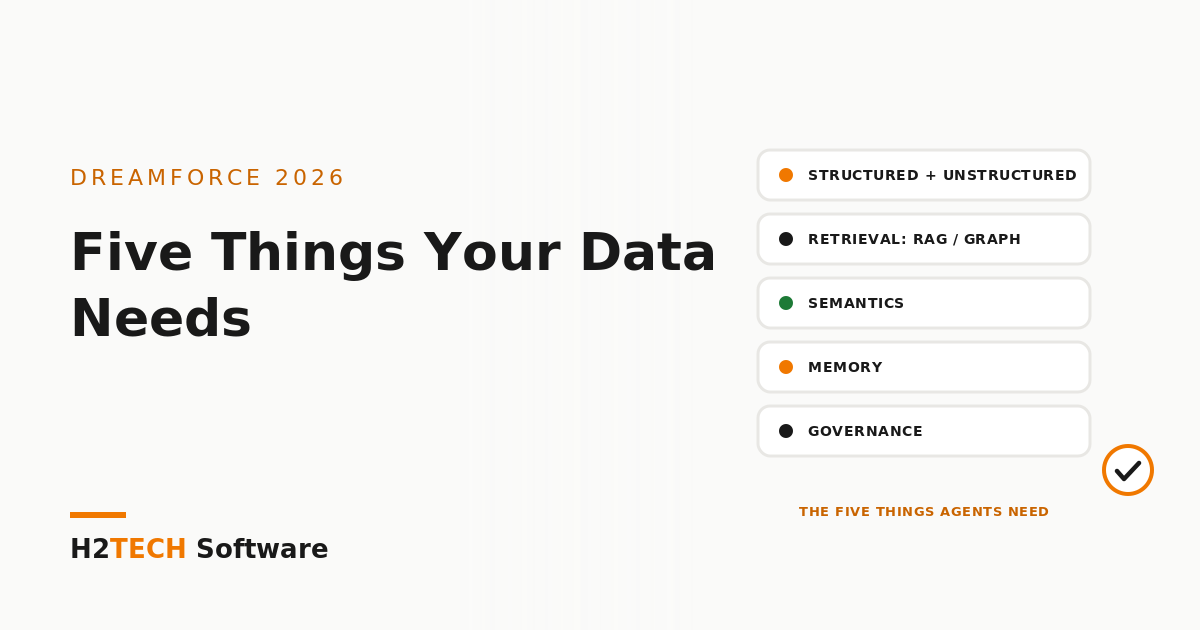
Amid the AIforce and Claudeforce headlines, Dreamforce 2026 made one point that deserves more attention than it got: Salesforce laid out what an agent actually needs to be effective. The list was five things — structured and unstructured data, retrieval (RAG and GraphRAG), semantics, memory, and governance. It is a useful checklist, because every item is a data problem before it is an AI one. Here is what each means for the org you are about to point an agent at.
1. Structured and unstructured data, both usable
Agents reason over your records and your documents — the opportunity and the contract, the case and the knowledge article. Most orgs have the structured side under some control and the unstructured side scattered across drives, inboxes, and PDFs nobody has indexed. Before Agentforce, the question is not “do we have the data” but “can an agent actually reach and trust both kinds.” If half the context lives in a folder the platform cannot see, the agent works with half a picture.
2. Retrieval that finds the right thing (RAG and GraphRAG)
Retrieval is how an agent pulls the relevant fact at the moment it answers. Plain RAG matches on similarity; GraphRAG follows the relationships between records — this account, its parent, its open cases, its entitlements. That relationship graph only helps if it exists and is intact in your org. If your lookups are broken or your hierarchy is a mess, retrieval returns confident nonsense. This is the same reason preserving the relationship graph matters so much in a migration: the connections are the context.
3. Semantics: fields that mean what they say
An agent takes your schema literally. If a field labelled “Region” actually stores a sales team, or “Status” means something different in two business units, the agent will use it exactly as written and be exactly wrong. Semantics is the unglamorous work of making sure the meaning of a field matches its name and is consistent across the org. It is also the work most teams skip — and the one that most reliably produces answers that are plausible, fluent, and false.
4. Memory: context that carries across interactions
A useful agent remembers what happened last time — the earlier case, the previous quote, the commitment made on the last call. Memory turns a series of one-shot answers into something that behaves like a colleague. But memory built on duplicated or contradictory records remembers the wrong things. If one customer exists as three accounts, the agent’s “memory” is three partial histories that never reconcile. Clean, deduplicated data is what makes memory an asset instead of a liability.
5. Governance: the guardrails that make it safe to ship
Governance is what lets you put an agent in front of real customers without holding your breath. It is your permissions and sharing model, your field-level security, your audit trail, and a clear line for where a human signs off. Dreamforce put governance on the same footing as the data itself, and rightly so — it is the difference between a production deployment and a proof-of-concept that never leaves the demo. For regulated and EMEA teams, this is where most of the real work sits.
The pattern behind all five
Notice what these have in common: not one of them is solved by choosing a better model. Structured and unstructured data, retrieval, semantics, memory, governance — all five are decided by the state of your Salesforce org long before an agent is configured. That is the honest lesson of Dreamforce 2026. The platform got dramatically more capable; the bottleneck moved firmly to your data foundation.
It is also good news, because it means the work is knowable and you can start now, without waiting for any product to reach general availability. Fix the data, map the meaning, tighten the governance, and the agent you build on top has a real chance of surviving contact with customers.
Where we come in
This is the core of how we do AI enablement: we treat the data foundation as the project, not the prerequisite. We dedupe and repair the relationship graph, map field semantics, and put the governance in place — then build the agent, AI-native, with a certified engineer reviewing every output. An agent is only ever as good as the five things beneath it.
Key takeaways
- Dreamforce 2026 named what agents need: structured and unstructured data, retrieval (RAG/GraphRAG), semantics, memory, and governance.
- All five are data-foundation problems, not model problems — they are decided by the state of your org, not your choice of AI.
- You can start today: clean the data, repair the relationship graph, align field meaning, and tighten governance before you configure the agent.